
ASPIRE by the Numbers: 2021 – 2023
Date:
December 19, 2023
Date:
December 19, 2023
By: Bianca Contreras
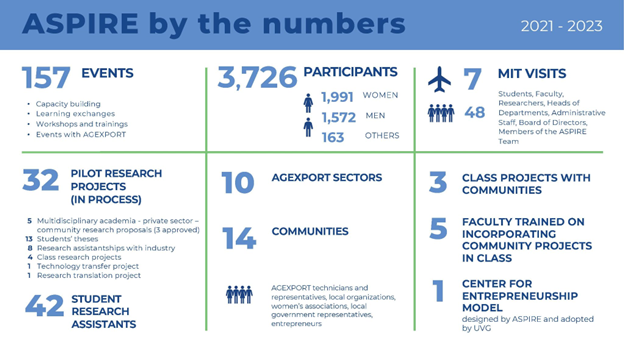
As 2023 comes to a close, the ASPIRE project team has taken the opportunity to look back at the first two years of implementation. One of the tools that helped us put the first two years into perspective is the infographic shown below. We thought you might be interested in it, too. While the ASPIRE by the Numbers 2021-2023 provides a birds-eye view of some of the key advances of the project, over the coming months, we’ll delve into each with more detailed news stories and graphics. For now, this version is accompanied by a brief description of each of the major categories shown.
- 157 Events: The project has sponsored four types of events over the last two years, including:
-
- Workshops and Trainings: Students and faculty from UVG, staff from UVG and AGEXPORT, community members and others have participated in workshops and training sessions on research, entrepreneurship, innovation and other topics. The events tend to be shorter in duration, from one session that takes a few hours to an entire day, for example.
- Capacity building: These activities go beyond one session or a workshop. Instead, they are multi-session events that over time, lead to new and/or improved skills and abilities. For example, researchers, professors, ASPIRE team members and other participants have improved their capacity to provide mentoring programs and services to entrepreneurs and incorporate the concept of participatory design into research projects and class projects.
- Learning Exchanges: These activities are information-sharing sessions designed to bring people together from within and outside the project, to share experiences and/or expertise. They could spark future training and capacity-building activities within ASPIRE, or allow ASPIRE to share its experiences with others. The project has sponsored nearly 30 Learning Exchanges in the last two years on a wide variety of topics including value chains, intellectual property processes in Guatemala, and enabling wheelchair accessibility in low-resource areas, among many others.
- Events with AGEXPORT: UVG and AGEXPORT have collaborated in a number of areas including: the identification of priority sectors within which to conduct collaborative research projects, the design and implementation of semester-long research assistantship opportunities for UVG students, and the sponsoring of student and faculty visits to AGEXPORT member company businesses, among other activities.
-
- 3,726 Participants: Participation in the project-related activities mentioned above has been robust during the first two years, with 53% self-identifying as female, and 42% self-identifying as male.
- MIT Visits: These activities are important opportunities for the project’s Guatemala partners to visit the MIT campus and learn about its innovation ecosystem, and its support for research, entrepreneurship and innovation. Different teams visit MIT at least once per year.
- Pilot Research Projects and Student Research Assistants: Involving a variety of stakeholders in research projects within and outside the classroom is a fundamental part of the ASPIRE projects. The variety of research initiatives is reflected in the infographic. Key aspects of collaborative research projects include their multidisciplinary nature and the participation of academia (UVG), the private sector (AGEXPORT), and communities. ASPIRE is strengthening researchers’ ability to implement research results, research translation, and technology transfer.
- AGEXPORT Sectors and Communities: As mentioned, ASPIRE strives to bring together academia, the private sector and communities in a variety of research, entrepreneurship and innovation activities. This is important because this type of multi-sectoral collaboration is still relatively new in Guatemala, and these experiences can be building blocks for future collaborative endeavors.
- Class Projects with Communities: ASPIRE recently completed its first round of three class projects with communities, in which students worked closely with different community groups on projects identified by the communities. Through these projects, the teams applied participatory design techniques. To assist the students and communities, five UVG faculty were first trained in these techniques, incorporated them into existing courses, and trained their students on their use. The students then applied the techniques with their respective community groups in their projects.
- Model for the UVG Entrepreneurship Center, CREA: The team created a model for a new UVG-based Entrepreneurship Center, UVG-CREA, which was presented to the university’s Board of Directors and subsequently accepted. The Center will be the hub of the project’s entrepreneurship activities, which will use the model, titled El Camino del Emprendedor, to engage and support entrepreneurs on their journey.
About ASPIRE
The Achieving Sustainable Partnerships for Innovation, Research and Entrepreneurship (ASPIRE) Project is a five year, $15 million project funded by USAID and implemented by the Massachusetts Institute of Technology (MIT), Universidad del Valle de Guatemala (UVG), and the Guatemalan Exporters Association (AGEXPORT) with the goal of creating a world-class, replicable model for how Latin American universities, in collaboration with the private sector, government and local communities, can respond to local and regional development needs. The project implements a collaborative approach based on MIT´s experience in the innovation ecosystem.