
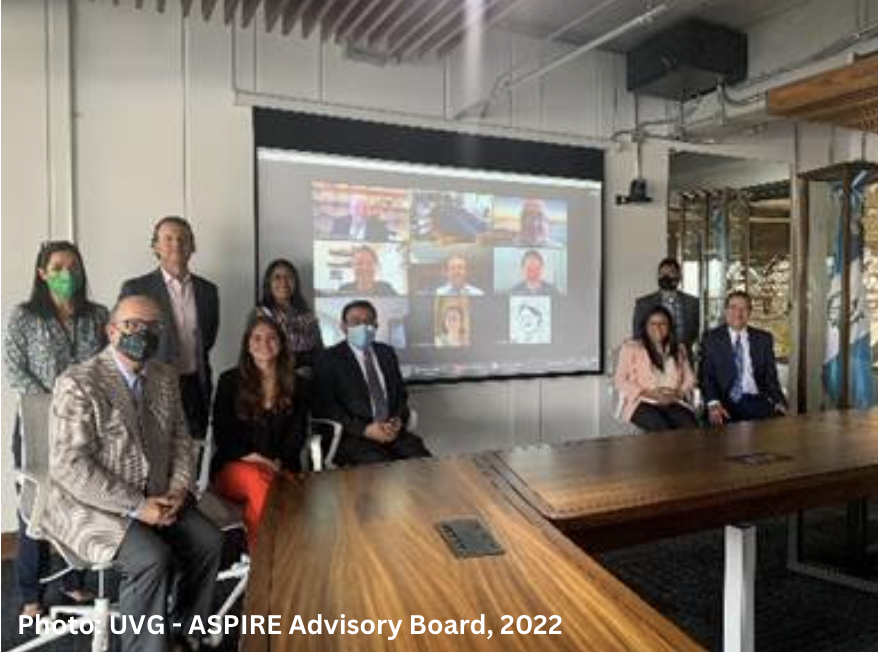
ASPIRE Advisory Board’s Inaugural Meeting
Date:
April 12, 2022
Date:
April 12, 2022
By: admin
The project’s Advisory Board conducted its first meeting, a hybrid in-person/virtual gathering, on March 10, 2022 at Universidad del Valle in Guatemala City. Twelve Advisory Board members from diverse sectors participated along with seven ASPIRE team members from MIT, UVG, and AGEXPORT. The advisory board’s role is to provide guidance to the ASPIRE team to help make the project more sustainable, establish connections to relevant actors, identify existing assets, challenges, and opportunities, share information about ASPIRE, and advocate for the project. After a presentation of the ASPIRE project and a review of the Board’s role, participants engaged in a valuable discussion about how the project can respond to needs in respective members’ sectors, and how the Board can serve as an important hub to share information, advise the project, and facilitate communication and coordination – with the project and among the represented organizations. The Advisory Board representatives are essential stakeholders within ASPIRE.
Government, the private sector, and diverse civil society organizations which support research, higher education, innovation, inclusion, entrepreneurship, and economic opportunity are represented on the Board. Members expressed enthusiasm for the project, whose vision is to create a replicable, world-class model for how higher education institutions and their collaborators in the private sector, government, and local communities can address local and regional development challenges.
Throughout the meeting, members emphasized the timing is right for ASIRE, a five-year, $15 million project financed by USAID and implemented by MIT, UVG and AGEXPORT – to foster cross-sectoral collaboration in Guatemala and execute practical activities that have impact. Topics for future discussion and collaboration in this forum include, among others:
1. Sustainability: Establish the approaches to ensure sustainability
2. Diagnostics: Ensure that the project’s seven first year diagnostics yield practical, locally-appropriate recommendations for future activities
3. Learning Exchanges: Participants identified potential future themes for these discussions, which bring diverse groups together to share experiences and approaches to ASPIRE-related topics.