

Exploring Snow Pea’s Protein Potential
Date:
January 11, 2024
Date:
January 11, 2024
By: Janine Sazinsky
A recently completed, semester-long research assistantship led by Sara Vielman, a Food Science Engineering major at Universidad del Valle de Guatemala (UVG)’s Central Campus, has yielded intriguing insights into the potential of the snow pea protein. This investigation, conducted in collaboration with the AGEXPORT Snow Pea and Vegetables Commission, holds significant promise for advancing the snow pea sector in Guatemala—one of the ASPIRE project’s priority sectors for research and innovation.
The snow pea (Pisum sativum L.) has emerged as a high-value resource in Guatemala’s economy, with a significant share of national production being destined for export to international markets, benefitting both producers and the economy. However, a pressing challenge confronts the sector: a considerable portion of harvested snow peas fails to meet stringent export-quality standards. While efforts to improve post-harvest handling represent one avenue for mitigating this issue (ASPIRE is doing research on this), another solution is to explore commercially viable uses for snow peas that do not meet export standards. As a result, within the framework of the ASPIRE project’s research assistantship pilot initiative, UVG and AGEXPORT arranged for a UVG student to conduct a semester-long research project to explore possible uses for non-export quality snow peas.
The Research Assistant, Sara Vielman, sought to explore this challenge by focusing her thesis work on the extraction and isolation of snow pea protein using the isoelectric precipitation method. Her results yielded an impressive 92.4% protein purity, and also showed promise for potential practical application, described below.
The impact of her research was not limited to the characterization of this protein isolate, but also extended to the evaluation of its physicochemical and functional properties. This additional analysis demonstrated that snow pea protein possesses ideal properties for food applications, highlighted by its water absorption capacity, emulsifying activity, emulsion stability and its foaming qualities, all important factors for potential food application.
Additionally, Sara’s research found that snow pea protein has high antioxidant and polyphenol levels, commonly known as antioxidants, which are beneficial to our health. The polyphenol content and antioxidant activity of foods are all characteristics gaining importance in the food industry, as consumers are seeking healthier and more nutritious foods.
Based on her findings, Sara proposed some interesting potential applications in food science. For example, one opportunity could be to replace the eggs in mayonnaise with the snow pea protein isolate, which would act as the “glue” to hold the mayonnaise ingredients together, instead of the egg. Doing this would allow for the resulting mayonnaise to still be well-mixed with a desirable consistency.
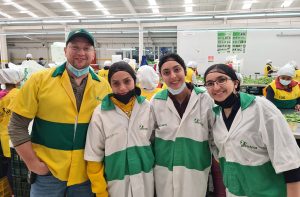
Sara Vielman on a field visit. Photo: UVG
Additionally, Sara prototyped a drink that included the snow pea protein as a supplement. The prototype not only met the required physicochemical standards to ensure food safety, authenticity and nutritional quality, but also received high marks for its texture, color and flavor qualities.
On a personal level, Sara encountered and overcame different challenges by making adjustments in her methodology, always with determination and in the spirit of learning. The ASPIRE project not only provided Sara with financial support and access to raw materials from AGEXPORT companies which are part of its Snow Pea and Vegetables sector, but also enabled her to appreciate a broader vision of the collaboration between academia and industry. Her project highlights the importance of active participation from companies in research projects and how effective these collaborations can be for innovation when applying practical scientific findings.
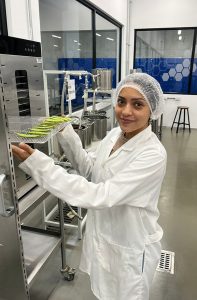
Sara Vielman. Snow pea dehydration process. Photo: UVG
The advice and guidance from experts in UVG’s Food Science Engineering department also provided important contributions to the depth and quality of Sara’s work.
Sara’s research has not only contributed to the scientific advancement in food science, but has also laid the foundation for possible industrial applications. Her work represents an important advancement in snow pea research, and exemplifies the transformative potential of collaborations between academia and industry, opening new perspectives in the landscape of science and innovation.
About ASPIRE
The ASPIRE Project is a five-year, $15 million project funded by USAID and implemented by the Massachusetts Institute of Technology (MIT), Universidad del Valle de Guatemala (UVG), and the Guatemalan Exporters Association (AGEXPORT), with the goal of creating a world-class, replicable model for how Latin American universities, in collaboration with the private sector, government, and local communities, can respond to local and regional development needs. The project implements a collaborative approach to research, teaching, innovation, entrepreneurship, and tech transfer, based on the combination of local assets and knowledge with MIT’s experience in the innovation ecosystem.