
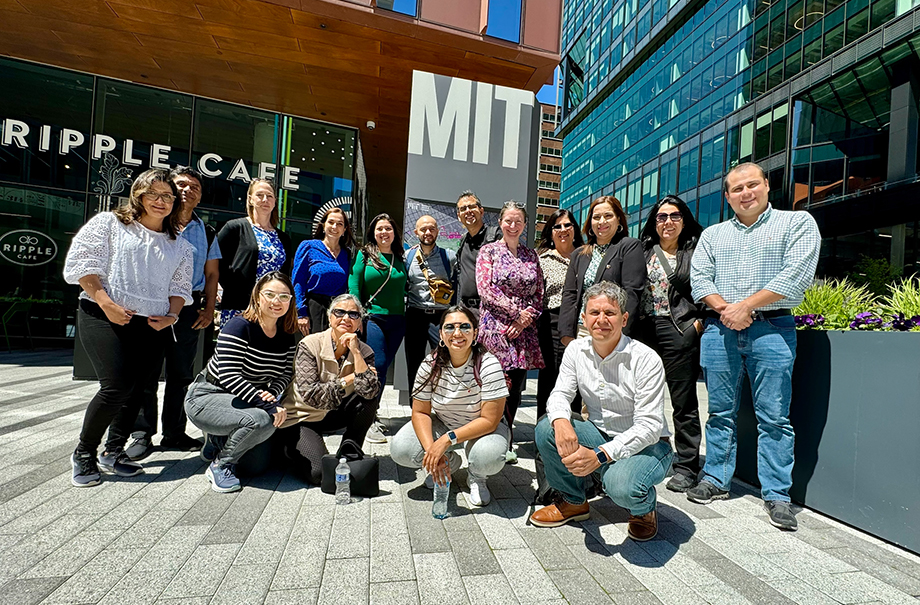
UVG administration visits MIT in May 2024
Date:
June 1, 2024
Date:
June 1, 2024
By: Janine Sazinsky
Photo: Visiting UVG administors outside of MIT in Kendall Square, Cambridge. Credit: Fernanda Morales.
During the second week of May, key UVG administrators visited MIT and participated in a three-day visit involving meetings and tours on campus. The objective of the visit was to gain insight into MIT’s systems, structures, and best practices supporting research, innovation, and technology transfer.
Innovation at MIT
On the first day, MIT Engineering Professor Jose Pacheco welcomed the UVG visitors, provided a history of MIT’s innovation ecosystem, and led an engaging campus tour. They were guided through the Media Lab, witnessing and learning firsthand about the interconnectedness that drives its innovation within MIT. Additionally, they toured the Martin Trust Center, learning how this unique center bridges academic and entrepreneurial pursuits to foster innovation.
Exploring Research Systems
The next day consisted of tours and meetings focusing on MIT’s research systems. Conversations centered around MIT’s research security and integrity, research compliance, administrative operations related to grants and contracts, and intellectual property management and patenting strategies with MIT professionals. These discussions were constructive and helpful as UVG visitors could ask questions and explore big-picture ideas with the experience and insight of their MIT hosts. The explored interesting and insightful new pathways and ideas to approach improvements in the unique nature of UVG’s research administration.
One of the visitors, Luz Coyoy, The Secretariat of Institute Research at UVG, believes the visit provided unexpected insights and hopes to adapt some of MIT’s ideas to benefit UVG, including the use of some valuable technological tools to support research administration and its management processes, particularly in the areas of research project and service management, purchases, and financial reports. “Knowing that they have a 100-year plan was something that caught my attention, although it seems very far away, the results are achieved with small activities carried out day by day…Collaboration and teamwork allow them [researchers] to deliver timely reports to donors. In short, I think the visit was very valuable, and I hope that as a team, we can implement best practices according to UVG’s environment.”
Nancy Adams and Sophia Chen presented a tour of the MIT D-Lab, showcasing examples of the program’s collaborative academic approaches and practical ideas to address global poverty. Their visit to the Social Science Research Center (SSRC) and the Harvard Blavatnik Biomedical Accelerator further enriched the UVG team’s understanding of research support structures and opportunities for collaboration at MIT.
The UVG team gained valuable understanding from their visit to the Office of Strategic Alliances & Technology Transfer, particularly how MIT fosters partnerships and facilitates technology transfer—a key translational component for UVG and the ASPIRE Program’s initiative.
Overall, the visit to MIT provided UVG administrators with a wealth of knowledge and insight that may enhance research, innovation, and technology transfer at their institution. For UVG and ASPIRE, the exchange of ideas will continue as both work together to translate learning into actions that drive positive regional impact.
About ASPIRE
The Achieving Sustainable Partnerships for Innovation, Research, and Entrepreneurship (ASPIRE) Project is a five-year, $15 million project funded by USAID and implemented by the Massachusetts Institute of Technology (MIT), Universidad del Valle de Guatemala (UVG), and the Guatemalan Exporters Association (AGEXPORT). Its goal is to create and share replicable models for how Latin American universities, in collaboration with the private sector, government, and local communities, can respond to local and regional development needs. The project implements a collaborative approach to research, teaching, innovation, entrepreneurship, and tech transfer, based on the combination of local assets and knowledge with MIT’s experience in the innovation ecosystem.