
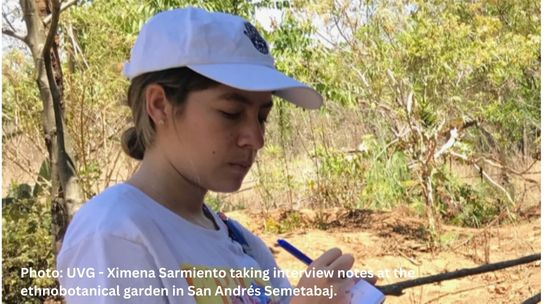
Elizabeth Hoffecker, Co-PI for ASPIRE, and two UVG students conduct field research on inclusive innovation projects in Sololá
Date:
September 1, 2023
Date:
September 1, 2023
By: Alison Young
Elizabeth Hoffecker, Co-PI for the ASPIRE Project at MIT, along with two UVG undergraduate students with whom she has been working closely for over a year, conducted a week of joint field research at the Universidad del Valle de Guatemala (UVG) Altiplano campus in April, 2023. The research team visited three research sites to investigate four examples of inclusive innovation projects involving staff and students from the Altiplano campus, as well as local community members and other stakeholders were occuring. The primary objective of the trip was to gather enough information about these projects from a variety of different stakeholder perspectives to be able to write case studies about the projects, illustrating how these examples of local, development-oriented innovation had come about.
When asked about her motivation for developing these case studies Ms. Hoffecker responded:
“[Upon] reviewing the UVG [innovation] ecosystem diagnostic data, it was clear that there was a need to bring awareness and visibility to these existing examples of inclusive innovation. Case studies like these can serve to inspire and motivate others to engage in similar work while showing them that this kind of project is possible, and is, in fact, already being done. They also shed some light on what is required from a practical standpoint to engage in this type of work in order to help others have a realistic understanding of what is involved in engaging in this type of innovation.”
UVG Student Participation
Ximena Sarmienta and Camila del Cid, the two UVG anthropology students participating in this trip, have experience collaborating with ASPIRE’s diagnostics team. Over the past year, they have both worked to develop the diagnostics related to UVG’s innovation ecosystem that eventually resulted in this April field research trip.
When these students expressed interest in participating in this research opportunity, they were immediately brought onboard, with Ms. Hoffecker acting as their Technical Mentor. ASPIRE’s Engagement and Research Transfer Coordinator, Sofia Mazariegos, supported this work as a guide along their journey.
By interviewing a diverse set of key actors associated with these community projects, Ximena and Camila gained invaluable practice navigating a more nuanced collaborative approach to case study research. In addition to their in-the-field experience, the work also fulfilled a requirement necessary for the completion of their undergraduate degree at UVG.
The Inclusive Innovation Projects
The field research sites visited by the team were located in San Andrés Semetabaj, the UVG Altiplano campus, and San Juan La Laguna. The four projects that were subject to this research were carried out by a diverse set of actors who wished to address local challenges in a way that would produce feasible solutions. To advance their projects, participants underwent a project design process that included identifying community problems, utilizing novel problem-solving methodologies, and engaging a diverse set of community actors in the work to ensure outcomes would align with community needs. These pieces are essential to the development of all inclusive innovation projects.
The topics of the projects covered during the field research site visits were: 1) Innovation in teaching materials for children; 2) Environmental education kit on phytoplankton; 3) Ethnobotanical garden at San Andrés Semetabaj; 4) Cotton yarn spinner at Casa Flor Ixcaco.
While in San Juan La Laguna, a village on the shores of Lake Atitlán, the field research team gathered insights into a mechanical cotton thread spinner, designed and developed by members of an artisan indigenous women’s weaving cooperative, Casa Flor Ixcaco, in collaboration with Jeremías Morales from the UVG Maker Space, Na’ojilal. The field research team also spent time with staff from the nonprofit Heifer International, who are responsible for providing innovative support for artisanal handicraft production and cultural tourism.
While in San Andrés Semetabaj, the field research team conducted research at the ethnobotanical garden and eco-museum, related to innovation in sustainable and cultural tourism. Finally, during their time at UVG’s Altiplano campus, they gathered information on educational innovation projects focused on children with disabilities, and environmental education around water quality of Lake Atitlán.
Next steps for Inclusive Innovation
The case studies resulting from this field research trip will include a description of the four successful innovation projects, a chronological narrative of how the innovations developed, what the innovation process entailed, and an explanation of results emerging from these processes. The case studies will look at factors that have enabled the development of the innovations, as well as factors that have created challenges or barriers for these projects. The authors will also attempt to extract general lessons for those interested in engaging in these types of projects in similar contexts. UVG students, faculty, and staff are expected to be the primary audience for this information. The team will, therefore, prioritize publishing the case study reports in Spanish, and making them available publicly for those who would like to learn more.
What is ASPIRE?
The Achieving Sustainable Partnerships for Innovation, Research and Entrepreneurship (ASPIRE) Project is a five-year, $15 million project funded by USAID and implemented by the Massachusetts Institute of Technology (MIT), Universidad del Valle de Guatemala (UVG) and the Guatemalan Exporters Association (AGEXPORT). The goal of the project is to create a world-class, replicable model for how Latin American universities and their collaborators can respond to local and regional development needs. The project implements a collaborative approach to research, teaching, innovation, entrepreneurship and tech transfer, based on the combination of local assets and knowledge with MIT’s experience in the innovation ecosystem.