

Academia is a key actor to strengthen the innovation ecosystem in Guatemala
Date:
November 9, 2023
Date:
November 9, 2023
By: Janine Sazinsky
On October 2, 2023, the Volcano Innovation Summit organization held its annual Volcano Innovation Summit in Antigua, Guatemala. This three-day event brings together national and international entrepreneurs and leaders to learn about new trends in innovation and entrepreneurship. This year, participants included national and international entrepreneurs, intrapreneurs, executives, investors and influencers.
During the event, which had over 100 different sessions with 225 presenters, there were different types of activities such as: Startup pitches, fireside chats, investor panels, keynote presentations, a business fair and networking activities, all related to entrepreneurship, innovation, fintech, technology, sustainability, wellness and investment.
Noteworthy at this year’s edition is the fact that the Summit organizers offered UVG the opportunity to participate in one of their fireside chats titled “Bridging Gaps in Startup Ecosystems.” UVG was pleased to have Fernando Paiz, MBA. and Dean of the UVG School of Engineering, join Michelle Lane Messina, CEO of Explora International LLC and author of the book “Decoding Silicon Valley,” in the session. This participation was a coordinated effort between the Business & Management School (BMS), the CREA Center for Entrepreneurship at UVG and the ASPIRE Project.
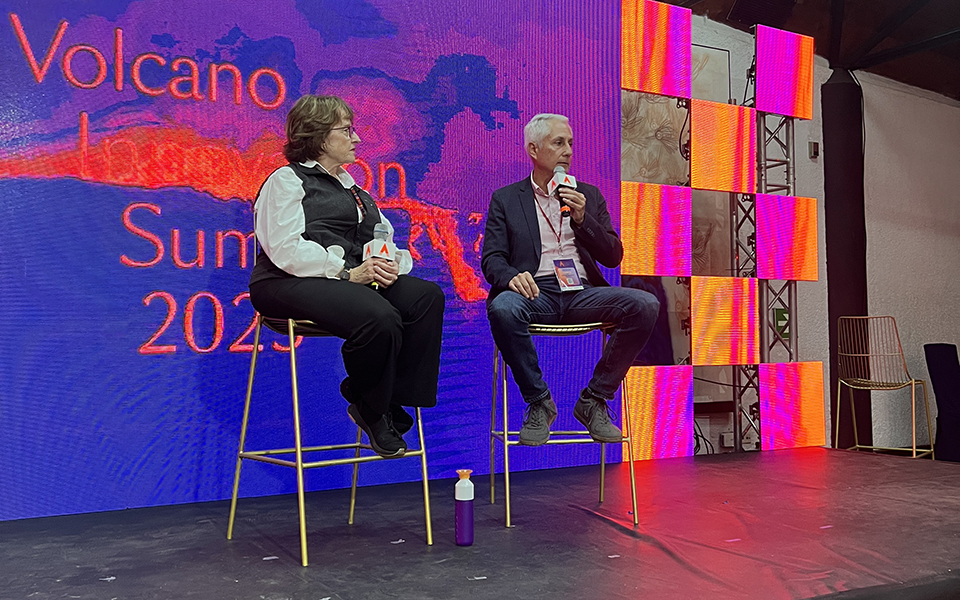
Michelle Lane Messina and Fernando Paiz during their talk at the Volcano Innovation Summit 2023. Photo: UVG
Participation of UVG and the ASPIRE project in this event stems from the desire to support the integration and strengthening of the innovation and entrepreneurship ecosystem of Guatemala. Furthermore, the UVG Business Management School (BMS), UVG CREA and ASPIRE collaborated with the participation of UVG students who worked as volunteers during the event, helping with the logistics.
The conversation between Paiz and Messina was based on four key points: the difficulties and challenges of being an entrepreneur, the importance of being an active member within the entrepreneurship ecosystem, the maturity of the ecosystem and the importance of having all members of the ecosystem.
On the first point, they stated that among the difficulties and challenges of being an entrepreneur, there are soft skills such as leadership, team building, training in entrepreneurship, support, and mentoring, learning what investors and consumers are looking for, aside from learning to iterate, which is defined as the ability to ideate, test and fail.
Secondly, the importance of being an active member within the entrepreneurship ecosystem means that interaction is critical for the development of trust between actors. In addition, openness and willingness to collaborate with other actors are required for the development of entrepreneurship.
Third, ecosystem maturity is the issue that tries to explain that all ecosystems are incomplete, even those as successful as Silicon Valley, California. They also emphasized that Guatemala has mature actors in a developing ecosystem, which has a lot of potential for the growth of the local ecosystem.
Fourth, in relation to the importance of the participation of all members of the ecosystem, the following question was asked: Who leads our ecosystem? To which both concluded that there is not a leader, but a coordination and collaboration of members who play an active role in developing trust and results within the ecosystem. Lastly, the goal of all members should be to strengthen it so that all members have confidence in the ecosystem and make it successful.
UVG CREA, with the support of ASPIRE and BMS, are entities that facilitate the interaction of active members of the innovation and entrepreneurship ecosystem and are always looking for new opportunities and initiatives to achieve links between all members of the ecosystem, especially the connection between industry, academia and communities. Finally, it is known that a successful ecosystem has an efficient link between key actors, thus achieving an ideal habitat for the development of new ideas, empowering its participants to continue working in the innovation and entrepreneurship ecosystem of Guatemala.
About ASPIRE
The Achieving Sustainable Partnerships for Innovation, Research and Entrepreneurship (ASPIRE) Project is a five year, $15 million project funded by USAID and implemented by the Massachusetts Institute of Technology (MIT), Universidad del Valle de Guatemala (UVG), and the Guatemalan Exporters Association (AGEXPORT). Its goal is to create a world-class, replicable model for how Latin American universities, in collaboration with the private sector, government and local communities, can respond to local and regional development needs. The project implements a collaborative approach to research, teaching, innovation, entrepreneurship, and tech transfer, based on the combination of local assets and knowledge with MIT’s experience in the innovation ecosystem.