
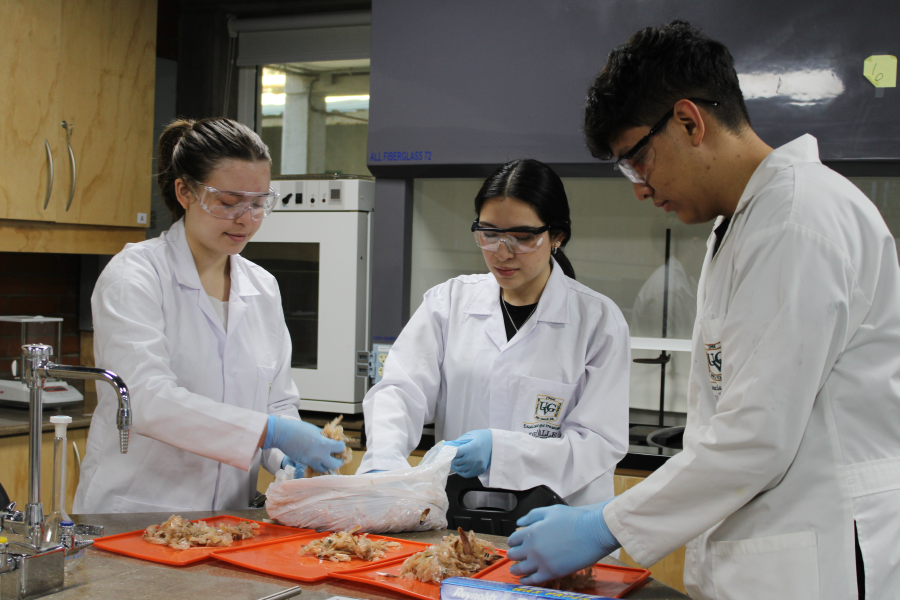
The Impact of Multidisciplinary Scientific Research: Harnessing Chitosan Nanoparticles for Water Treatment
Date:
August 9, 2024
Date:
August 9, 2024
By: Bianca Contreras
Guatemala faces significant challenges in providing clean water to its inhabitants. Many communities are affected by this issue, not only in terms of accessing water but also in accessing treated water. To tackle this issue, the ASPIRE Project assembled a diverse team of UVG students from different disciplines, students from the Massachusetts Institute of Technology (MIT), and researchers from UVG and the UVG Office of Technology Transfer (OTT). Their collective goal is to propose a solution to the problem of emerging contaminants and heavy metals in water. AGEXPORT serves as the industry partner in this project, supporting the students by donating shrimp shells to start research at the laboratory level.
Magnetized shrimp particles
The presence of heavy metals, such as lead and arsenic, and emerging contaminants like ibuprofen, triclosan, and diclofenac in water is a significant concern. These contaminants are dissolved and invisible to the human eye, making it challenging to determine the water’s safety. To tackle this problem, the ASPIRE project has gathered a team to focus on a sustainable solution that employs shrimp shells, currently regarded as waste in the shrimp industry. The project aims to extract chitosan from the shrimp shells, turning them into magnetized chitosan nanoparticles. These nanoparticles have the capability to capture heavy metals and emerging contaminants present in water, thereby improving water quality using repurposed byproducts of the shrimp industry in a sustainable way.
The team consists of UVG students from various disciplines, including Chemistry, International Marketing and Business Analytics, Industrial Chemical Engineering, and Anthropology, as well as MIT undergraduate students specializing in Brain and Cognitive Sciences, Biology, and Chemical Engineering with a particular focus on Material Science Engineering. In their pursuit, they have faced challenges and gained a better understanding of integrating diverse perspectives and disciplines in scientific research. For example, groups learned about and considered product design and market dynamics when assessing future products and applications resulting from their research.
Members of AGEXPORT’s aquaculture and fishing sector played crucial roles by providing guidance on shrimp product export regulations to the United States.
The importance of multidisciplinary research
Several students mentioned that they had never worked on multidisciplinary research before. Luisa Garcia, a 4th-year marketing student at UVG, noted that working with bachelor’s students in chemistry and industrial chemical engineering helped her appreciate the support of teamwork. She learned that “everyone helps each other in everything.” Raúl Barillas, a 3rd year Marketing student, was pleasantly surprised by the challenges of the projects, as he had to “learn to perform tasks he had not undertaken before.” He noted the positive support he received from his classmates.
Hugo Escobar, 4th year Chemistry student, expressed, “What has helped me the most (about collaborative work) is learning how to implement (research) to make a product.” Through interactions with students from different fields, it has been possible to explore various products derived from magnetized chitosan nanoparticles for water treatment. In other words, Hugo says, collectively, they were able to explore “how to make this technology reach the people.”
Throughout the research process, Chemistry students were observed not only working together in their lab, but also sitting down with students from different majors for productive brainstorming sessions. This interdisciplinary approach expanded their perspectives and facilitated an exploration into the practical applications for products using Chitosan nanoparticle magnetization technology, which could potentially be introduced to the market. María Fernanda Del Cid, a 4th-year Chemistry student at UVG, pointed out, “This technology is new in Guatemala,” suggesting that there are numerous untapped potential applications to be explored.
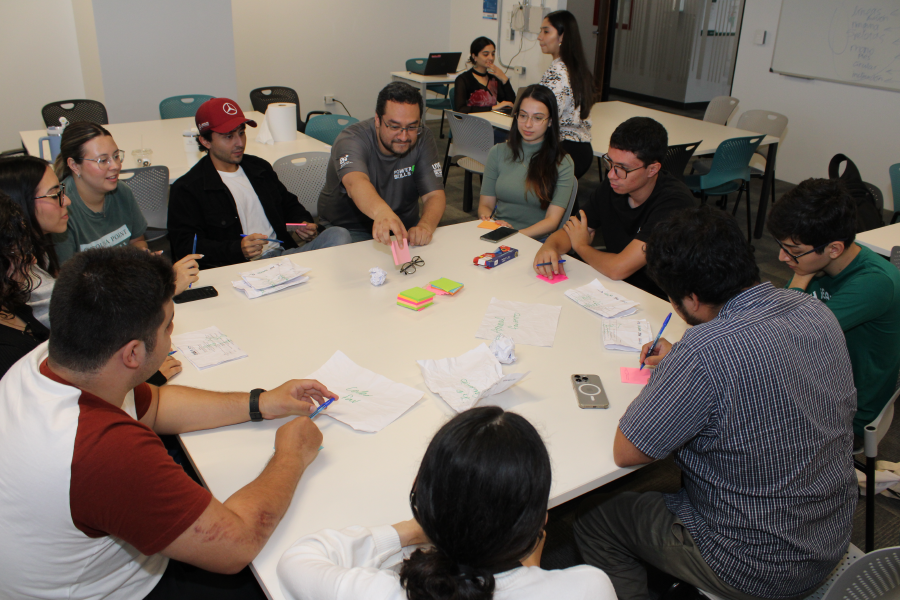
First multidisciplinary brainstorming session with all the project students. Photo: ASPIRE
Lourdes Figueroa, Project Manager of UVG’s Office of Technology Transfer (OTT), comments that “we have all learned a lot, and the added value (of multidisciplinary work) opens your mind.” Allan Vasquez, principal Chemistry researcher and professor at UVG, also praised the multidisciplinarity component, noting that “the different disciplines help each other, in addition to finding new solutions with different people who are experts in their areas.”
The ASPIRE project involved students pursuing their bachelor’s degree in Anthropology to document the project’s process, as the project has a strong interest in multidisciplinary research. Carmen Gómez, a 5th-year anthropology student, explained her role in the project as being to “understand quite well what is being done, so that the multidisciplinary research can be replicated.” The goal of the ASPIRE project is to create a world-class, replicable model for how Latin American universities address local development priorities through their research, teaching, innovation, and entrepreneurship activities, making the outcomes of this project important for building the replicable ASPIRE model.
The importance of communication
One of the major challenges this diverse group of professionals faces is communication, as each professional communicates in a language specific to their area. However, the group has overcome this obstacle through various communication strategies. Paulina Leal, a 4th-year Chemistry student, mentioned that “speaking clearly” – meaning not using technical language with people who do not have that knowledge – helped a lot in avoiding communication problems. Along with clear communication, students pointed out that having an open mind is essential to making the most of contributions from all disciplines. This change in mentality has streamlined teamwork.
Hugo said that “meeting each other in person” also helps improve communication because, through these face-to-face interactions, each professional can better understand what each one does.
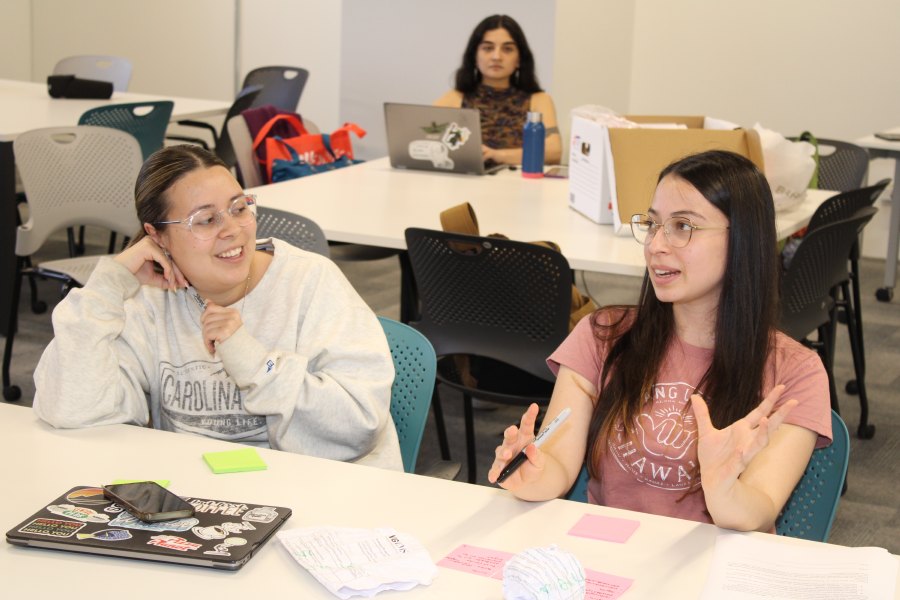
Students during the second multidisciplinary brainstorming session. Photo: ASPIRE
Impact in Guatemala
In conclusion, the students emphasized the significance of this research for Guatemala. Paulina mentioned that this research “offers many opportunities for Guatemala to introduce a new product.” Additionally, Hugo stated that the project will showcase that “(innovative) research is being conducted in Guatemala.” Lourdes remarked that finding a new use for shrimp waste adds value to the country. María Fernanda also highlighted that this research serves as a reminder that young people are capable of producing high-level research and that “experiences like these allow us (young people) to explore our potential.”
Multidisciplinary research is uncommon, but this project demonstrates the value of professionals from different fields collaborating to address a national challenge.
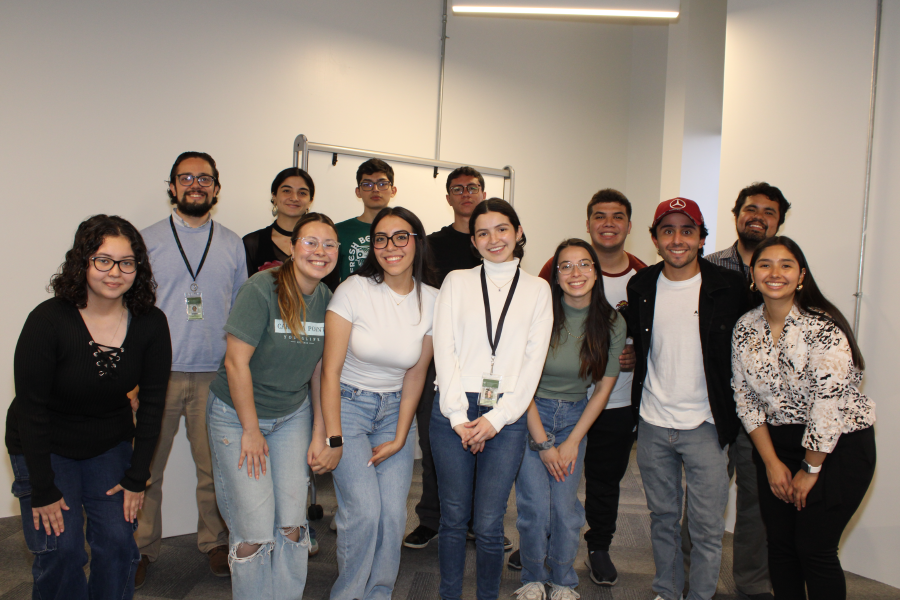
Chemistry and Marketing students with staff from the ASPIRE project. Photo: ASPIRE
About ASPIRE
The Achieving Sustainable Partnerships for Innovation, Research and Entrepreneurship (ASPIRE) Project is a five-year, $15 million project funded by USAID and implemented by the Massachusetts Institute of Technology (MIT), Universidad del Valle de Guatemala (UVG), and the Guatemalan Exporters Association (AGEXPORT), with the goal of creating a world-class replicable model for how universities, in collaboration with the private sector, government, and local communities, can respond to local and regional development needs. The project implements a collaborative approach, based on MIT’s experience in the innovation ecosystem.