
ASPIRE Advances with RETOS Platform Prototype to develop collaborative solutions to real challenges in a Digital Workspace
Date:
August 16, 2023
Date:
August 16, 2023
By: Alison Young
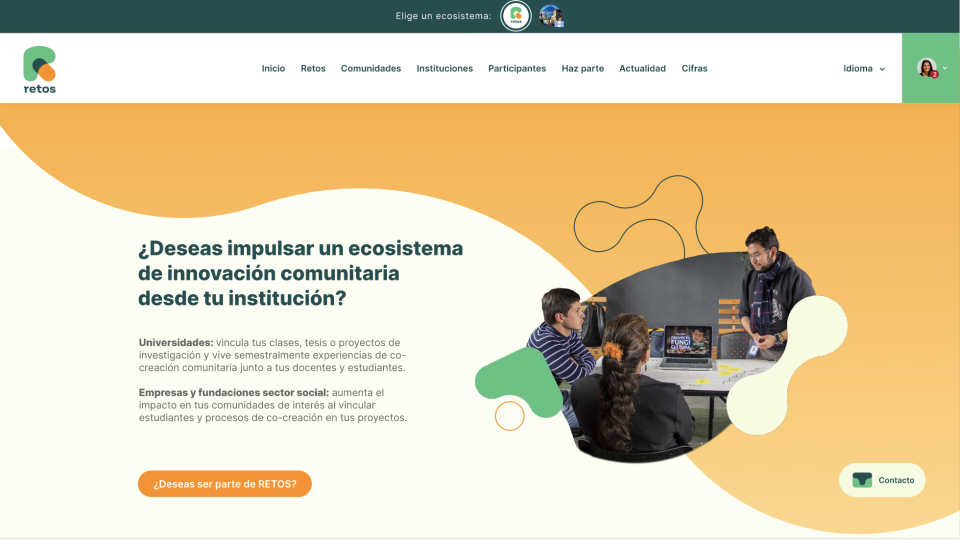
ASPIRE is working with RETOS, a robust, customizable, digital platform that supports collaborative solution-building for specific, real-world problems (“challenges”). RETOS was originally designed by the Colombia-based non-profit, Diversa, which also possesses expertise in managing the digital platform’s practical application with a variety of stakeholders, especially in the university setting.
Diversa’s custom-built technology connects individuals or groups who have identified a felt need or challenge they would like to address with people who have information, experiences, and resources that could help work on that challenge. By making this connection via RETOS, these groups can jointly seek potential solutions with locally available resources.
ASPIRE has worked closely with Diana Duarte Gomez, Co-founder of Diversa, and her team since Fall 2022 to develop this multifaceted platform prototype. Within ASPIRE, RETOS will connect key stakeholders, such as UVG students, teachers, and researchers with diverse industry partners, such as AGEXPORT member companies that request assistance to research challenges, community groups, other civil society organizations, and government. Together, these groups will share their expertise and brainstorm solutions online and in person.
The RETOS digital ecosystem will enable users to document challenges that can be worked on by the range of stakeholders mentioned above and in many different ways, including class projects, research assistantships, and collaborative research projects, among others. For example, the platform will be used to support class projects at UVG, and collaborative research projects with UVG-AGEXPORT-communities in export value chains jointly identified by UVG and AGEXPORT. The platform will also support the storage, organization, and access to relevant research documentation and end-data that help stakeholders create a roadmap of take-aways and guidance to address similar issues in the future. By making the documentation, updates, and reports contained on the platform publicly available, RETOS will function as an open source reference for users.
After working through multiple prototypes, the platform’s functionality is now being tested with real-time UVG-based projects. For example, in one of four class research projects scheduled for this year academic year, microbiology students, in collaboration with an AGEXPORT member company, conducted research which compared two different methods of extracting the essential oils from four different plants in an effort to explore improved extraction methods that could also prove beneficial for production. This challenge, and information related to the research, was uploaded to the RETOS platform, and can serve as a source of connecting, information-sharing, and learning.
In order to maximize the platform’s benefit, Diversa and ASPIRE encourage combining its use with concepts related to participatory design, a family of approaches that actively involve problem holders to ensure that the designed product or service is sustainable and beneficial. For example, training in participatory design techniques is an integral part of the class projects and other research projects currently underway at UVG.
Diversa uses a continuous improvement approach with the platform, incorporating feedback from early tests and the larger ASPIRE team regularly. This will ensure the tool’s effectiveness and sustainability over time.
Success with the RETOS platform will be reflected in multiple ways within the ASPIRE Project’s inner workings and offerings to key stakeholders. Among the most positive desired outcomes are the propagation of opportunities for strengthening community bonds, developing entrepreneurship and ‘outside the box’ thinking for students, and reinforcing the utilization of collaborative approaches to successfully address challenges for a variety of unique stakeholder needs. RETOS will also support ASPIRE’s goal of producing a replicable model for development for communities through the important partnership between academia and industry.
What is ASPIRE?
The Achieving Sustainable Partnerships for Innovation, Research and Entrepreneurship (ASPIRE) Project is a five-year, $15 million project funded by USAID and implemented by the Massachusetts Institute of Technology (MIT), Universidad del Valle de Guatemala (UVG) and the Guatemalan Exporters Association (AGEXPORT). The goal of the project is to create a world-class, replicable model for how Latin American universities and their collaborators can respond to local and regional development needs. The project implements a collaborative approach to research, teaching, innovation, entrepreneurship and tech transfer, based on the combination of local assets and knowledge with MIT’s experience in the innovation ecosystem.