
ASPIRE and AGEXPORT work alongside UVG Students and Researchers to Collect Findings using New Technology from APAESA
Date:
August 17, 2023
Date:
August 17, 2023
By: Alison Young
Since its inception in 2021, ASPIRE has sought to create and foster partnerships with organizations whose missions support the advancement of agricultural production and export in Guatemala, among other key research, innovation, and entrepreneurship topics. Among these partnerships, APAESA has stood out in advancing innovation in the field of essential oil production. APAESA is a global, sustainability focused company designing and marketing innovative fragrances in the Central American and Caribbean markets. To support their work in essential oil extraction, APAESA purchased a device called the Ultrasonic Vibration Machine (UVM). Ultrasonic vibration technology has the potential to help Guatemalan essential oil producers scale their laboratories and increase production of oils used in medicine and cosmetics.
Students use New Technology in the Laboratory
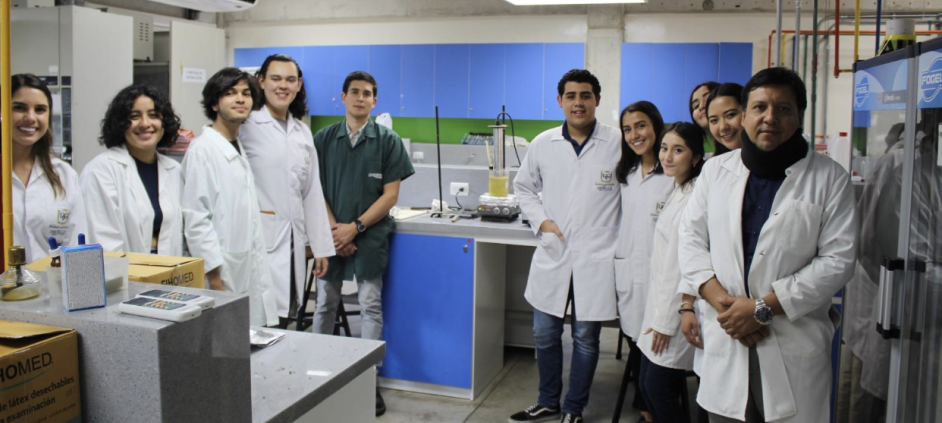
Earlier this year, APAESA generously lent their UVM to UVG and, on May 11th, UVG’s Microbiology students were given the opportunity to use this technology in a laboratory setting. The UVM device aims to simplify the essential oil extraction process by reducing extraction time and increasing yields. This experiment provided students experience with this new tool and elevated their research findings with its data. Yields were obtained from two extraction techniques for the following plant varieties: thyme, rosemary, palmarosa, and ginger.
For the students who participated, the experience of working alongside professionals from APAESA was valuable in giving them practical, real-world experience. As Jeber Barahona, a UVG Microbiology student participant in the experiment stated, “It allowed me to perform as a professional even when I was in the fifth semester of the university and experiment, for the first time, with ultrasonic vibration technology.”
The results obtained from these experiments taught the UVG Microbiology students more about the methodological aspects of the essential oils extraction process. Particular attention was paid to the parameters of the experiment that must be considered and measured to obtain accurate results. These parameters must be understood and carefully monitored to take full advantage of all the benefits that this technology offers, such as shorter extraction times and higher yields.
The experiment also provided evidence of the need to continue exploring and experimenting with ultrasonic vibration technology for industry in Guatemala. The results of this experiment present another advantage to carrying out more research projects in utilizing these methods. The partnership with APAESA, combined with the introduction of this new technology, showed ASPIRE researchers and UVG-ASPIRE students how we can build sustainable alliances with different actors in an organic way, and that, through collaboration, we can learn and generate information that is beneficial to actors in a variety of sectors, industries, and disciplines.
By utilizing the innovative technology and applying new problem-solving approaches, such as participatory design, UVG-ASPIRE students will develop skills to upload and track their work in the RETOS platform. RETOS is a customizable digital platform that is currently being prototyped and implemented within ASPIRE. The RETOS platform was developed by Diversa, a Colombia-based organization. This platform will allow key stakeholders, including producers of agriculture-related consumables, researchers, students, and faculty, to work together in solving systematized challenges facing various productive sectors. The use of the RETOS platform will promote common-interest partnerships between stakeholder groups, and the potential for these relationships to continue beyond ASPIRE’s involvement.
What is ASPIRE?
The Achieving Sustainable Partnerships for Innovation, Research and Entrepreneurship (ASPIRE) Project is a five-year, $15 million project funded by USAID and implemented by the Massachusetts Institute of Technology (MIT), Universidad del Valle de Guatemala (UVG) and the Guatemalan Exporters Association (AGEXPORT). The goal of the project is to create a world-class, replicable model for how Latin American universities and their collaborators can respond to local and regional development needs. The project implements a collaborative approach to research, teaching, innovation, entrepreneurship and tech transfer, based on the combination of local assets and knowledge with MIT’s experience in the innovation ecosystem.