
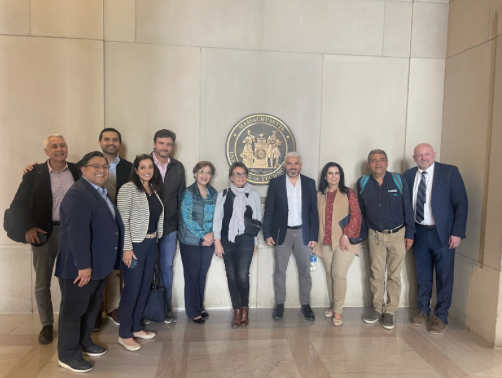
UVG Authorities Visit MIT – May 16-18, 2023
Date:
August 15, 2023
Date:
August 15, 2023
By: Alison Young
During the week of May 16-19th, 2023, 9 visitors from the Universidad del Valle de Guatemala (UVG) – including five members of the UVG Board of Directors, three UVG University Deans, and the Director of the UVG Altiplano Campus – participated in a Learning Exchange at the Massachusetts Institute of Technology (MIT). Through meetings, tours, and discussion, the UVG officials learned more about how MIT’s innovation ecosystem works and grows. This collaborative engagement supports long-term planning for the ongoing Achieving Sustainable Partnerships for Innovation, Research, and Entrepreneurship (ASPIRE) Project.
The ASPIRE Project is a five-year, $15 million effort conducted by officials at UVG, MIT, and the Asociación de Exportadores de Guatemala (AGEXPORT). The project is funded out of USAID’s Bureau for Development, Democracy, and Innovation (DDI)/Innovation, Technology and Research Hub (ITR), and falls within the Building Research and Innovation, Generating Evidence, and Training (BRIDGE-Train).
MIT’s Innovation Ecosystem
The first day of the three-day agenda included an overview of the MIT innovation ecosystem and visits with RAS (Research Administration Services), D-Lab, and TLO (Technology Licensing Office). José Pacheco, co-director of the master’s program in Advanced Manufacturing Engineering and Design, offered an engaging historical review of MIT’s innovation ecosystem and its growth over time. Professor Pacheco traced the origins of the ecosystem back to WWII and highlighted key milestones in subsequent decades, including the creation of MIT’s Venture Mentoring Services (VMS), and the Morningside Academy, among others.
The group then moved to an informative meeting with Sharon Ray and Brendan O’Brine at RAS, where they learned about how that office is structured and works to successfully coordinate with sponsored research project teams and others, and effectively manage grant programs. The UVG visitors asked a variety of questions as they explored potential ways to incorporate RAS’s extensive experience and practical tools into UVG’s own operations.
Later in the day, Nancy Adams, MIT D-LAB, provided a tour for the UVG officials and shared an overview of D-Lab’s experience incorporating student practical design into development projects, which have been evolved by applying D-Lab’s principal concepts like participatory design and inclusive innovation. UVG officials were given the opportunity to try for themselves several prototypes designed and produced by students over the years.
To complete day one, the group met with Ben Rockney of MIT’s Technology Licensing Office (TLO). Mr. Rockney provided the group with insight on commercializing MIT intellectual property, followed up by an overview of how MIT approaches disseminating their technologies into the hands of those who can develop it further and use said technologies to impact the world.
Day two of the visit started with a meeting at MIT’s VMS, Venture Mentoring Service, in which VMS representatives Ariane Martins, Jerome Smith, and Louis Goldish shared how their program supports entrepreneurs, promoting ideas and products into practice and real companies. The group also discussed VMS’s support to UVG to help it create a mentoring program at UVG. The next stop on the UVG officials’ tour was to MIT’s Media Lab where Micha Feigin-Almon and Maggie Church presented a history of the lab, and how it serves to bring MIT’s research to life resulting in global visibility and impact. Day two concluded with a visit to the Martin Trust Center, where UVG officials spoke with Jenny Larios Berlin and Devon Sherman Daley and learned how the entrepreneurial spirit is cultivated and supported at MIT, spurring important discussions around the growth of UVG’s entrepreneurial culture.
The last day of the visit began at the newly-created Morningside Academy for Design, where a presentation and tour were given by John Ochsendorff, Professor of Architecture and Civil and Environmental Engineering and Founding Director of the Academy. Professor Ochesendorff provided insight into how the Academy is structured, and how design is used to connect people to innovation and technology, with connections being made to the needs and possible advancements worldwide. Professor Ochsendorff’s tour was capped by a photo opportunity in front of the Morningside Academy’s future home, currently being built in the previous Metropolitan Warehouse on campus. Finally, the MIT Alumni Association sat down with the group to discuss the many important ways in which MIT alumni play a role in supporting the innovation ecosystem and entrepreneurial endeavors.
In addition to the invaluable knowledge sharing and learning, representatives of the offices with whom the Board met shared copies of their presentations so that they could be used as a future technical reference. The representatives from MIT also agreed to be available for future questions and consultations with UVG. Both of these resources serve to grow the UVG Board members’ professional network and strengthen ties between UVG and MIT.
Sincere thanks go to the MIT representatives and many ASPIRE community members who shared how their group fits within MIT’s larger innovation ecosystem.
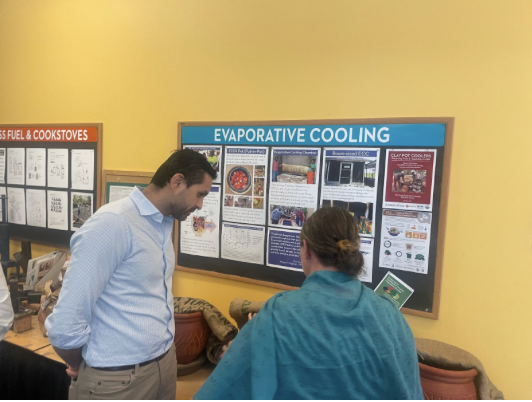
UVG Board member Ramiro Castillo and ASPIRE co-principal investigator Kendra Leith, at D-Lab. Image: MIT
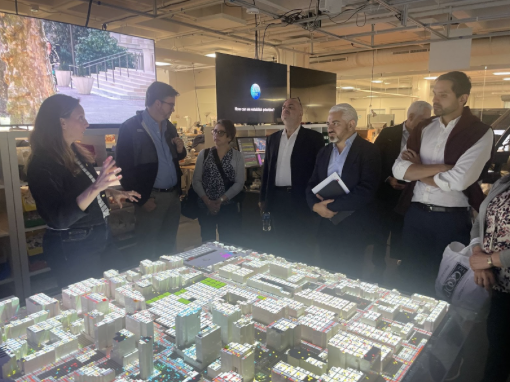
UVG leadership speaks with Margaret Church of the Media lab about her research. Image: MIT
What is ASPIRE?
The Achieving Sustainable Partnerships for Innovation, Research and Entrepreneurship (ASPIRE) Project is a five-year, $15 million project funded by USAID and implemented by the Massachusetts Institute of Technology (MIT), Universidad del Valle de Guatemala (UVG) and the Guatemalan Exporters Association (AGEXPORT). The goal of the project is to create a world-class, replicable model for how Latin American universities and their collaborators can respond to local and regional development needs. The project implements a collaborative approach to research, teaching, innovation, entrepreneurship and tech transfer, based on the combination of local assets and knowledge with MIT’s experience in the innovation ecosystem.