
UVG Visits MIT for meetings that will contribute to strengthening capacities of individuals within the UVG innovation and entrepreneurship ecosystems
Date:
August 11, 2023
Date:
August 11, 2023
By: Alison Young
Academic Exchange and Training
A group of 19 people – students, academic and administrative staff – from the Universidad del Valle de Guatemala (UVG), participated in an Academic Exchange and Training program at MIT during the week of April 24-28, 2023. The trip is part of the five-year, $15 million USAID-funded project, ASPIRE (Achieving Sustainable Partnerships for Innovation, Research, and Entrepreneurship). The project is funded out of USAID’s Bureau for Development, Democracy, and Innovation (DDI)/Innovation, Technology and Research Hub (ITR), under the Building Research and Innovation, Generating Evidence, and Training (BRIDGE-Train), and is jointly implemented by MIT, UVG, and the Guatemalan Exporters Association, AGEXPORT.
Academic exchanges, Guatemala to the U.S. and vice versa, are an important feature of ASPIRE’s activities because they generate the sharing and learning between partners, which is essential to jointly implement activities in the project’s four main objectives: 1. Training, 2. Research, Entrepreneurship and Innovation, 3. Partnerships, Research Translation and Uptake, and 4. Culture and systems. During this trip, UVG participants learned more about how MIT is structured, organizationally and physically, how to apply participatory and inclusive training methodologies, and support innovation and entrepreneurship, among others. Additionally, a subset of the group participated in a two-and-a-half day training on how to create a mentoring program for entrepreneurs at UVG. In turn, ASPIRE and other MIT staff learned from our UVG counterparts how its resources can be applied most appropriately in the Guatemalan context. As a result, this exchange and training program bolsters efforts in all four of the project’s objectives.
3 Exchange Tracks
During their week at MIT, the 19 visitors from UVG participated in activities in three different tracks, including:
| Track | Description | Participants |
| 1. MIT Venture Mentoring Services (VMS) Training for UVG ASPIRE staff | Participated in an intensive 2.5 day “Immersion Program” for participants to understand the MIT VMS mentoring model, its services, and to begin to design the UVG-based program | 6 UVG staff who will design and manage the local mentoring program |
| 2. Innovation Ecosystem for students, faculty, researchers, and
administrative staff |
Visited various departments, offices, and labs which comprise the MIT Innovation Ecosystem | 12 UVG teachers, and staff |
| 3. Training | Met with various staff from MIT D-Lab to better understand methodologies like co-creation and inclusive innovation, and strengthen contacts and personal network with others around MIT like J-WEL and Co-Creation Studio | The ASPIRE Training Manager |
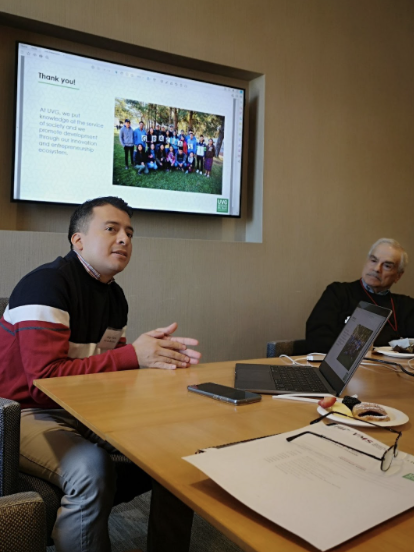
Presenting the UVG experience at the MIT VMS training. Image: UVG
MIT VMS Immersion Program
The Immersion Program for UVG staff at the MIT campus was the first of two essential trainings for UVG, which form the foundation for the support MIT VMS will provide to help UVG design and implement its own mentoring program in Guatemala. With MIT VMS support and guidance, UVG will design a program, which relies on Guatemalan mentors to volunteer their time to advise and support local, early-stage entrepreneurs. Interestingly, UVG is the 122nd partner that MIT VMS is working with during its storied 23-year history. Now that the Immersion Program is complete, participants have returned to Guatemala to continue designing their new program within UVG. The next training will occur in September, in which MIT VMS representatives will travel to Guatemala to train the first cadre of local mentors. After that training, UVG will implement a pilot mentoring program from October 2023 to August 2024. The pilot is intended to involve between 10-20 Guatemalan volunteer mentors who will work with 6-10 selected local ventures from the UVG community and AGEXPORT.
Learning about MIT’s Innovation Ecosystem
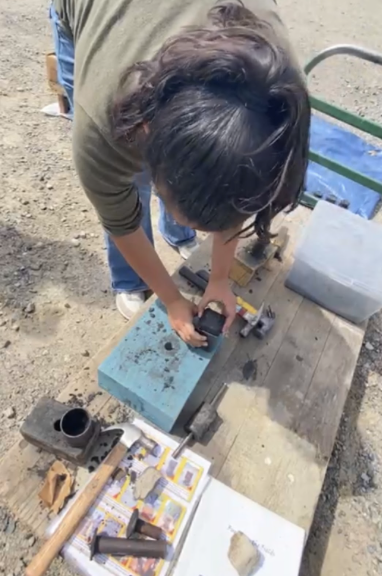
Hands-on experience creating charcoal briquettes in D-Lab’s Energy Class. Image: UVG
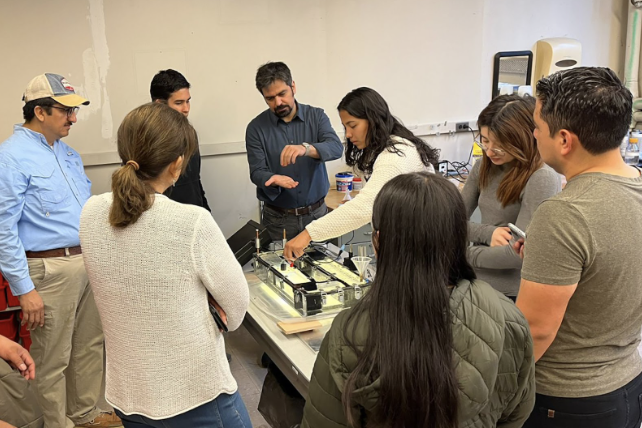
While UVG staff were engaged in the Immersion Program, 12 students, staff, and teachers spent five days learning about the MIT innovation, research, and entrepreneurial ecosystem, and potential applications at UVG. Participants visited a wide range of offices including D-Lab, MIT.nano, the Local Innovation Group at the Sociotechnical Systems Research Center (SSRC), Martin Trust Center for Entrepreneurship, the Abdul Latif Jameel Water & Food System Lab (J-WAFS), Research Administration Services (RAS), and the Office of First Year. They also participated in three Intro to Energy classes taught at D-Lab.
Important aspects of this part of the program included offering students, staff, and teachers the opportunity to see how MIT is physically and organizationally structured to support and engage in innovation, research, and entrepreneurship activities. For example, at J-WAFS and SSRC, participants learned how innovation can be successfully applied to practical research projects around the world. At MIT.nano, they saw first-hand how cutting-edge nanotechnology is being used to further our understanding of important topics in biology, technology, and other fields.
Throughout the visit, and particularly during the D-Lab classes and hands-on activities, they saw how students can create space to engage in innovation and entrepreneurship and work with local stakeholders to generate solutions to development challenges. Camila del Cid, a junior Anthropology student at UVG commented, “More than just brilliant minds, MIT brings together diligent, passionate, and well-meaning people from all over the world who, sometimes by accident, come up with great ideas over coffee.”
Strengthening UVG’s Training and Curricular Capacity
Finally, ASPIRE’s Training Manager spent the week talking with staff and students, meeting with different labs and offices, and sitting in on classes to gain a better understanding of how important topics like innovation and co-creation, among others, are used as teaching tools for practical application at MIT. She met with D-Lab staff and MIT students, and participated in a variety of D-Lab classes including Intro to Energy, D-Lab Design, and D-Lab WASH (Water and Sanitation for Health). She also participated in events like the D-Lab Design Challenge and the ‘Making Sustainable Design’ event held by the Morningside Academy.
Participants in all three tracks emphasized their pleasure at being able to experience first-hand MIT’s extensive engagement in participatory design, research, innovation, and entrepreneurship. Regina Fanjul, a Student Counselor at UVG, shared her reflections: “This trip changed my perspective regarding what is possible to achieve. It made me realize that, when you analyze problems methodically, it is possible to innovate and find solutions that can (positively) impact many lives. It helped me to verify that in Guatemala and UVG we have the same human potential, the same problems and even the same aspirations that people have in MIT, but the reason why they accomplish more than we do, is that they are not afraid to take risks, to fail, and to take “failures” as an opportunity to innovate and improve.”
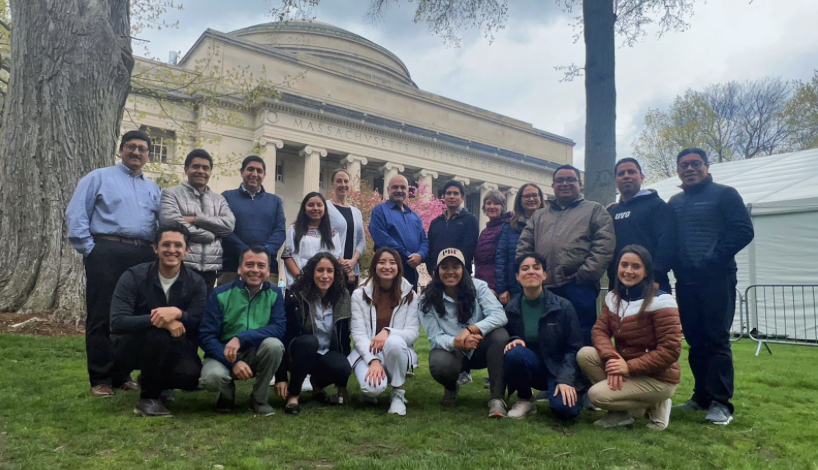
ASPIRE members from both MIT and UVG campuses gather on the lawn in April for their picture under the dome. Image: UVG